

Table of Contents
ToggleIntroduction
Education and training are becoming increasingly digital. Classrooms, training centres, workshops, and presentation rooms now need technology that does more than simply display information. Teachers and trainers need to explain ideas, demonstrate processes, encourage participation, share content, and collaborate with learners.
Traditionally, these activities depended on a combination of projectors, laptops, whiteboards, cables, and other equipment. While these tools remain useful, they can make lessons and training sessions less flexible.
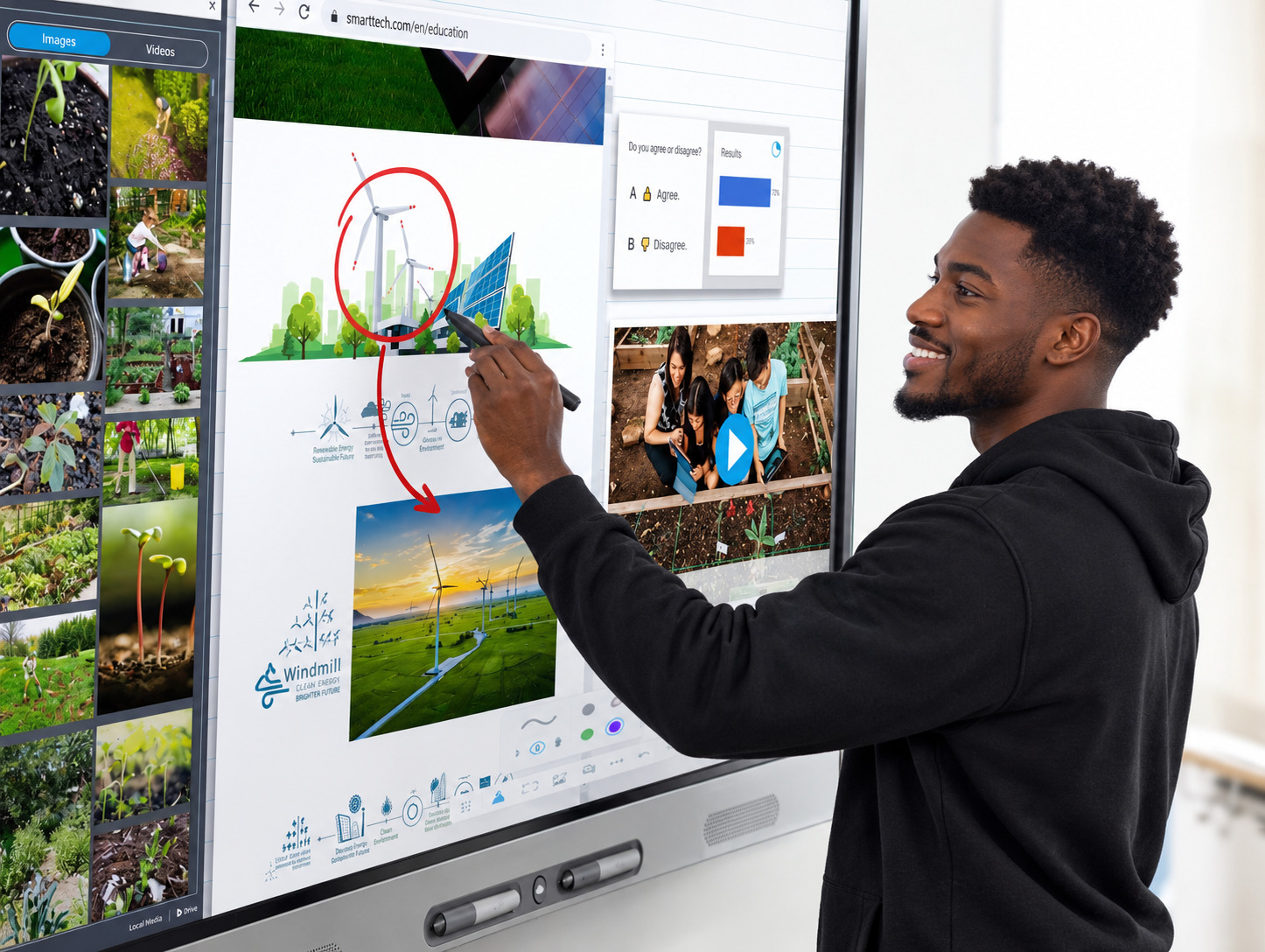
Interactive displays bring many of these functions together on one large touchscreen. Instead of simply showing a presentation, an interactive display allows users to write, annotate, move objects, share content, demonstrate information, and collaborate directly on the screen.
This makes interactive displays useful across schools, universities, corporate training environments, workshops, meeting rooms, and presentation spaces.
For a broader look at how this technology is being used beyond training environments, the discussion of [smart interactive displays in modern classrooms and workspaces] provides useful context on their wider applications.
Table of Contents
- Introduction
- What Is an Interactive Display?
- Why Interactive Displays Are Changing Education and Training
- How Interactive Displays Improve Learning and Presentations
- Interactive Displays and Hybrid Learning
- Key Benefits of Interactive Displays
- Interactive Display vs Projector vs Traditional Whiteboard
- Features to Look for in an Interactive Display
- How to Choose the Right Display for Your Room
- Common Mistakes When Buying an Interactive Display
- Best Practices for Deploying Interactive Displays
- The Future of Interactive Displays in Education and Training
- Key Takeaways
- Conclusion
- FAQs
What Is an Interactive Display?
An interactive display is a large touchscreen designed for presentations, training, collaboration, and digital whiteboarding. Unlike a conventional display, users can interact directly with the content using their fingers or a stylus.
Depending on the model, an interactive display may also support wireless screen sharing, video conferencing, built-in applications, multi-user interaction, and digital whiteboarding.
In simple terms, it changes the display from a passive viewing surface into a shared digital workspace.
For example, a teacher can display a lesson and write directly over it. A trainer can highlight part of a workflow while explaining it. Students can participate in an exercise on the screen, while employees in a training session can annotate a document or brainstorm ideas together.
Interactive displays therefore combine several functions that would traditionally require different pieces of equipment.
Why Interactive Displays Are Changing Education and Training
One of the biggest advantages of interactive displays is that they make learning and training more participatory.
Traditional lessons and training sessions can sometimes follow a one-way format: the teacher or trainer presents information while participants watch, listen, and take notes.
An interactive display creates more opportunities for people in the room to participate.
Training becomes more participatory
A trainer could display a workflow and ask participants to identify where a process could fail. A participant could then mark the relevant part of the workflow while the trainer explains the issue.
Similarly, a sales trainer could display a customer journey and ask participants to arrange different stages in the correct order.
The technology does not replace the teacher or trainer. Instead, it gives them another way to involve learners.
Lessons can become more engaging
Interactive displays allow educators to combine text, images, videos, diagrams, websites, and other digital resources in one lesson.
Instead of explaining a concept using only a static board, a teacher can demonstrate it visually and allow students to interact with the material.
This can be particularly useful when teaching subjects that benefit from diagrams, demonstrations, visual examples, or multimedia.
Trainers can annotate information in real time
Digital annotation is another important advantage.
A teacher or trainer can underline a sentence, circle a figure, draw an arrow, or write a note directly over presentation content. Depending on the display and software, these annotations can then be saved or shared.
This means participants can leave a lesson or training session with a digital record of important discussions rather than relying entirely on handwritten notes.
Multiple people can interact with content
Many modern interactive displays support multi-touch functionality. This allows several users to interact with digital content during collaborative activities, although the number of simultaneous touch points depends on the specific model.
This can be useful for brainstorming, workshops, group exercises, technical demonstrations, and classroom activities.
How Interactive Displays Improve Learning and Presentations
Interactive displays are not limited to classrooms. They can also improve business presentations, workshops, demonstrations, and professional training.
A presenter can move between slides, diagrams, documents, websites, videos, and other digital content without constantly switching between different devices.
For example, during a product presentation, a presenter could explain a product using slides, open a product diagram, zoom in on a component, annotate the design, play a demonstration video, and return to the presentation.
This creates a more connected presentation experience.
Interactive presentations can also encourage discussion. A management team could display a proposed business process and ask participants to identify possible problems. Team members could then annotate the process directly on the display.
The screen becomes part of the conversation rather than simply the background for it.
This is particularly valuable in training environments, where participants need to understand and apply information rather than simply watch it being presented.
Interactive Displays and Hybrid Learning
Hybrid learning and training require more than a large screen. People in the physical room need to communicate effectively with those joining remotely, while everyone should be able to access and contribute to the same information.
An interactive display can support this experience when combined with suitable cameras, microphones, speakers, reliable network connectivity, and collaboration software.
For example, imagine a trainer conducting a session for employees in Lagos, Accra, and Abidjan. Participants in the room can interact with the touchscreen while remote participants join through the organisation’s collaboration platform.
The trainer can use digital whiteboarding, share content, annotate information, and continue the discussion without treating remote participants as an afterthought.
However, the display itself does not create a successful hybrid learning environment. A complete setup may also require:
- A suitable conferencing camera
- Table or ceiling microphones
- Professional speakers
- Reliable internet connectivity
- A compatible collaboration platform
- Appropriate room acoustics
- A simple way for users to connect personal devices
This is why schools, training centres, and businesses should consider the entire room ecosystem rather than purchasing a display in isolation.
Key Benefits of Interactive Displays
Interactive displays can provide different benefits depending on the environment in which they are used.
Area | Potential Benefit |
Education | More engaging and participatory lessons |
Training | Easier annotation, demonstrations, and group activities |
Presentations | More dynamic content and interactive discussions |
Collaboration | Shared digital workspace for teams and learners |
Hybrid learning | Better integration of in-room and remote participation |
IT management | Opportunity to consolidate several room functions |
Room usage | One space can support training, presentations, meetings, and workshops |
One of the biggest benefits is collaboration. Instead of treating the display as an output device, teachers, trainers, employees, and students can use it as a shared workspace.
They can brainstorm ideas, review documents, map processes, discuss diagrams, and make changes in real time.
Interactive displays can also reduce dependence on projectors in some environments. Projectors remain useful for very large spaces and specific applications, but interactive displays can remove challenges such as shadows, alignment, and the need for a separate projection surface.
They can also make rooms more flexible. A training room could be used for employee onboarding in the morning, a presentation in the afternoon, and a hybrid meeting later in the day.
Interactive Display vs Projector vs Traditional Whiteboard
The right display technology depends on the room and its intended use.
Feature | Interactive Display | Projector | Traditional Whiteboard |
Touch interaction | Yes | Usually limited | Physical only |
Digital annotation | Yes | Limited | No |
Wireless sharing | Often available | Depends on setup | No |
Video playback | Yes | Yes | No |
Digital whiteboarding | Yes | Depends on software | No |
Hybrid collaboration | Strong when integrated | Requires additional equipment | Very limited |
Multi-user interaction | Available on many models | Limited | Physical only |
Content saving | Often available | Limited | No |
Best suited for | Collaboration and training | Large-scale viewing | Simple brainstorming |
For a small room that mainly displays slides, a conventional professional display may be enough.
For a large auditorium where the audience is far from the screen, a projector or large-format display solution may be more appropriate.
However, a training room used for workshops, demonstrations, brainstorming, and collaborative exercises can benefit significantly from an interactive display.
The important point is that an interactive display is not automatically the best choice for every room. Room size, viewing distance, content type, lighting, intended use, and budget should all influence the decision.
Features to Look for in an Interactive Display
Choosing an interactive display based only on screen size can create problems later. Schools and organisations should assess the complete specification.
Screen size and viewing distance
A larger screen is not automatically better.
A 55-inch display may work well in a small room but become difficult to read from the back of a larger training environment.
Common business and education sizes include 55, 65, 75, and 86 inches or larger. However, viewing distance, seating arrangement, content type, and lighting should ultimately determine the appropriate size.
Resolution
4K UHD is common in modern professional interactive displays.
Higher resolution can make text, diagrams, spreadsheets, presentations, and detailed visual content easier to view, particularly on larger screens.
Touch capability
A touchscreen specification should be examined beyond simply confirming that touch is available.
Look for:
- Number of simultaneous touch points
- Touch response
- Stylus support
- Writing accuracy
- Palm rejection
- Multi-user interaction
- Screen durability
Connectivity
Connectivity is another important consideration.
Depending on the room, the display may need HDMI, USB, USB-C, Wi-Fi, Bluetooth, Ethernet, wireless screen sharing, or screen mirroring.
USB-C can also make connecting compatible laptops more convenient by reducing the number of separate connections required.
Operating system and software
Some interactive displays include built-in operating systems and applications, while others work primarily with an external computer.
Neither approach is automatically better. The important consideration is whether the display fits into the organisation’s existing software, device-management, security, and support environment.
Video conferencing compatibility
If the display will be used for hybrid learning or meetings, check its compatibility with the organisation’s chosen collaboration platform.
Remember that a touchscreen display is not automatically a complete conferencing system. Cameras, microphones, speakers, and other conferencing equipment may still be required.
How to Choose the Right Display for Your Room
The best interactive display is not necessarily the largest or most expensive model. It should provide the right combination of size, interaction, connectivity, software compatibility, support, and reliability.
Start by defining the room’s purpose.
Ask whether the room will mainly be used for:
- Employee training
- Classroom teaching
- Presentations
- Workshops
- Brainstorming
- Client demonstrations
- Video conferencing
- Hybrid learning
- Sales presentations
Next, assess the physical environment. Consider room dimensions, seating capacity, viewing distance, screen position, lighting, power availability, network access, cable routes, and the placement of cameras, speakers, and microphones.
The organisation’s collaboration platform should also be considered. If users already rely on Microsoft Teams, Zoom, Google Meet, or another platform, compatibility should form part of the procurement requirements.
Finally, calculate the total cost of ownership. The purchase price is only one part of the investment. Installation, mounting, cabling, cameras, microphones, speakers, software, warranty, support, maintenance, network infrastructure, and energy consumption may also affect the overall cost.
Common Mistakes When Buying an Interactive Display
Buying based only on price
The cheapest option may not provide the durability, connectivity, software compatibility, or support required for a busy education or training environment.
Instead, compare the complete solution and expected usage.
Choosing the wrong screen size
A display that looks impressive in a showroom may not be appropriate for the actual room.
Always consider viewing distance before choosing screen size.
Ignoring audio
A good display cannot compensate for poor meeting or training-room audio.
Hybrid environments still require participants to hear and be heard clearly, so cameras, microphones, speakers, and other audio equipment should be considered alongside the display.
Ignoring network requirements
Wireless screen sharing and cloud-based collaboration depend on reliable connectivity.
IT teams should therefore assess network coverage, bandwidth, security, and access policies before deployment.
Failing to train users
Even a well-designed system may remain underused if teachers, trainers, and employees do not understand how to use it.
Basic onboarding should cover screen sharing, digital whiteboarding, annotation, device connection, presentation controls, video conferencing, and saving or sharing content.
Best Practices for Deploying Interactive Displays
Successful deployment begins before the display arrives.
Create a room technology checklist covering room dimensions, seating capacity, display size, mounting location, power, network connectivity, collaboration platform, camera requirements, microphone requirements, speakers, wireless sharing, security, device management, warranty, and support.
Organisations with multiple rooms can also benefit from standardisation. When similar displays and interfaces are used across classrooms or training rooms, users do not have to learn a completely different system every time they enter another room.
Accessibility should also be considered. Screen height, visibility, font size, contrast, physical access, and alternative interaction methods can affect how comfortably people use the room.
Most importantly, keep the user experience simple.
A complicated room with several remotes, adapters, and connection procedures can discourage adoption. Ideally, the workflow should feel straightforward:
Enter room → connect device → share content → collaborate → finish session.
The fewer unnecessary steps users encounter, the more confidently they are likely to use the technology.
The Future of Interactive Displays in Education and Training
The future of interactive displays will not simply be about installing larger screens. Displays are increasingly becoming part of broader connected learning and collaboration environments.
Modern rooms can bring together:
- Interactive displays
- Digital whiteboards
- Intelligent cameras
- Wireless presentation
- Cloud collaboration
- Room scheduling
- Digital signage
- AI-assisted tools
- Automated meeting summaries
- Voice interaction
The biggest change is therefore conceptual.
A traditional display answers the question, “What should everyone look at?”
Modern interactive technology increasingly answers a different question:
“What can everyone work on together?”
That distinction is important for both education and professional training. As schools, universities, businesses, and training organisations adopt more digital and hybrid ways of working, interactive displays can become central to how people teach, learn, present, and collaborate.
Key Takeaways
Interactive displays are changing education and training by making digital content more interactive and collaborative.
The main points to remember are:
- Interactive displays combine presentation, annotation, digital whiteboarding, and collaboration functions.
- They can make classroom lessons and training sessions more participatory.
- They can support presentations, demonstrations, workshops, and hybrid learning.
- They can reduce dependence on projectors in suitable rooms.
- The right screen size depends on viewing distance, room size, seating, and content.
- Touch capability, connectivity, software, and conferencing compatibility should be assessed before purchase.
- A successful installation requires more than the display itself.
- User training and a simple interface are important for adoption.
- The future of interactive displays is moving towards connected digital workspaces rather than simple presentation screens.
Conclusion
Interactive displays are transforming education and training by changing the role of the screen itself.
Instead of simply showing information, an interactive display can become a shared workspace where teachers, trainers, students, employees, and other participants can present, annotate, demonstrate, brainstorm, and collaborate.
The value of the technology, however, depends on how well it fits the environment. A successful deployment considers the room, viewing distance, connectivity, software, audio, video, user needs, and overall workflow.
When these elements work together, a classroom or training room becomes more than a place where people sit and watch a presentation. It becomes a flexible environment designed for active learning, collaboration, and modern communication.
For organisations planning to introduce this technology, the goal should not simply be to buy an interactive screen. The goal should be to create a room where the technology makes teaching, learning, training, and collaboration easier.
FAQs
An interactive display is a large touchscreen designed for presentations, education, training, digital whiteboarding, and collaboration. Users can interact directly with digital content using touch or a stylus.
Interactive displays allow teachers and trainers to combine presentations, videos, diagrams, annotation, digital whiteboarding, and collaborative activities. This can make learning and training more participatory and engaging.
In many small and medium-sized rooms, an interactive display can replace a projector. However, projectors may still be suitable for very large rooms or environments where a much larger projected image is required.
There is no single ideal size. Smaller rooms may work well with 55- or 65-inch displays, while larger training environments may require 75-, 86-inch, or larger displays. Viewing distance and seating arrangement should guide the decision.
Yes. Interactive displays can support hybrid learning when integrated with suitable cameras, microphones, speakers, network connectivity, and collaboration software. The display provides the shared interactive workspace, while the rest of the room technology connects in-person and remote participants.