

Table of Contents
ToggleIntroduction
Retail advertising is no longer limited to printed posters, banners, and price tags. Today, businesses can use digital screens to display promotions, introduce new products, and update marketing messages throughout the day. For retailers looking to make their storefronts and in-store campaigns more engaging, LED poster displays offer another option worth considering.
However, choosing the right screen involves more than looking at its appearance. Buyers need to understand resolution, brightness, viewing distance, installation requirements, and cost. In this guide, we explore how LED poster displays work, where retailers can use them, and what to know about the Unilumin Umake PT 1.8 before purchasing.
What is an LED poster display? An LED poster display is a digital screen that uses light-emitting diodes to show moving or static visual content. Businesses can use it instead of a traditional printed advertising poster, allowing them to change promotions, product images, videos, and announcements without printing new materials.
Table of Contents
- Introduction
- What Is an LED Poster Display and How Does It Work?
- Why Retail Businesses Are Using LED Poster Displays
- Unilumin Umake PT 1.8 Specifications and Features
- Unilumin Umake PT 1.8 Price in Nigeria
- LED Poster Display vs LCD Digital Signage for Retail
- Best Uses of LED Poster Displays in Retail Stores
- How to Choose the Right LED Poster Display
- Benefits and Disadvantages of LED Poster Displays
- Best Practices for Using LED Poster Displays
- Common Buying Mistakes and Future Trends
- Conclusion
- FAQs
What Is an LED Poster Display and How Does It Work?
An LED poster display is a digital advertising screen designed to present promotional content in a poster-like format. It combines a display panel, control electronics, and content playback functionality to show images, text, animations, and videos. Depending on the model, content may be managed through USB, a network connection, or dedicated software.
How does an LED poster display work?
LED stands for light-emitting diode. These small electronic components produce light, and groups of them form the pixels that create images on the screen.
When a retailer uploads an advertisement or video, the display system processes the content and presents it on the screen. Consequently, a single display can serve different advertising purposes throughout the day.
For example, a supermarket could display breakfast promotions in the morning, advertise a weekend discount in the afternoon, and feature a loyalty programme later in the evening.
Unlike a printed poster, the digital version does not need to be replaced whenever the message changes. Nevertheless, the screen still requires electricity, suitable content, and appropriate management.
What makes an LED poster different from a printed poster?
A printed poster communicates one fixed message until someone physically replaces it. In contrast, an LED poster display can present multiple advertisements in rotation.
This flexibility can be useful for retailers that regularly change prices, introduce products, or run short-term campaigns. It also allows businesses to use motion and colour to attract attention.
However, digital signage is not automatically better for every situation. Printed posters remain practical for inexpensive, permanent, or low-frequency messaging.
Why Retail Businesses Are Using LED Poster Displays
LED poster displays give retailers a way to present changing promotional content in a compact digital format. They can support product awareness, seasonal advertising, and brand communication at key points in the customer journey. Their value depends on how effectively the content reaches the intended audience.
Better visibility for promotional messages
A digital screen can combine colour, movement, and changing visuals to make an advertisement noticeable. This can help a retailer highlight a promotion or introduce a new product in a busy environment.
For instance, a fashion store can display a new collection near its entrance instead of relying solely on mannequins and printed posters.
Still, visibility depends on placement, surrounding lighting, screen size, and viewing distance. A display hidden behind merchandise may not perform well, regardless of its technical specifications.
Flexible advertising throughout the day
Retail promotions often change according to stock availability, shopping periods, and marketing campaigns. Digital displays make these changes easier because staff can update the content without printing replacement materials.
A cosmetics retailer, for example, might promote skincare products in the morning and highlight gift sets during a seasonal campaign. With suitable content management, the same screen can support both messages.
A more consistent brand presentation
Retailers can use digital signage to maintain consistent colours, logos, typography, and promotional designs across their stores. Moreover, centrally managed content may simplify updates across multiple locations if the chosen system supports remote management.
For businesses operating in Nigeria, Ghana, or Côte d’Ivoire, this could help coordinate campaigns across different branches. However, the ability to manage multiple displays remotely should be confirmed for the specific model and control system.
Unilumin Umake PT 1.8 Specifications and Features
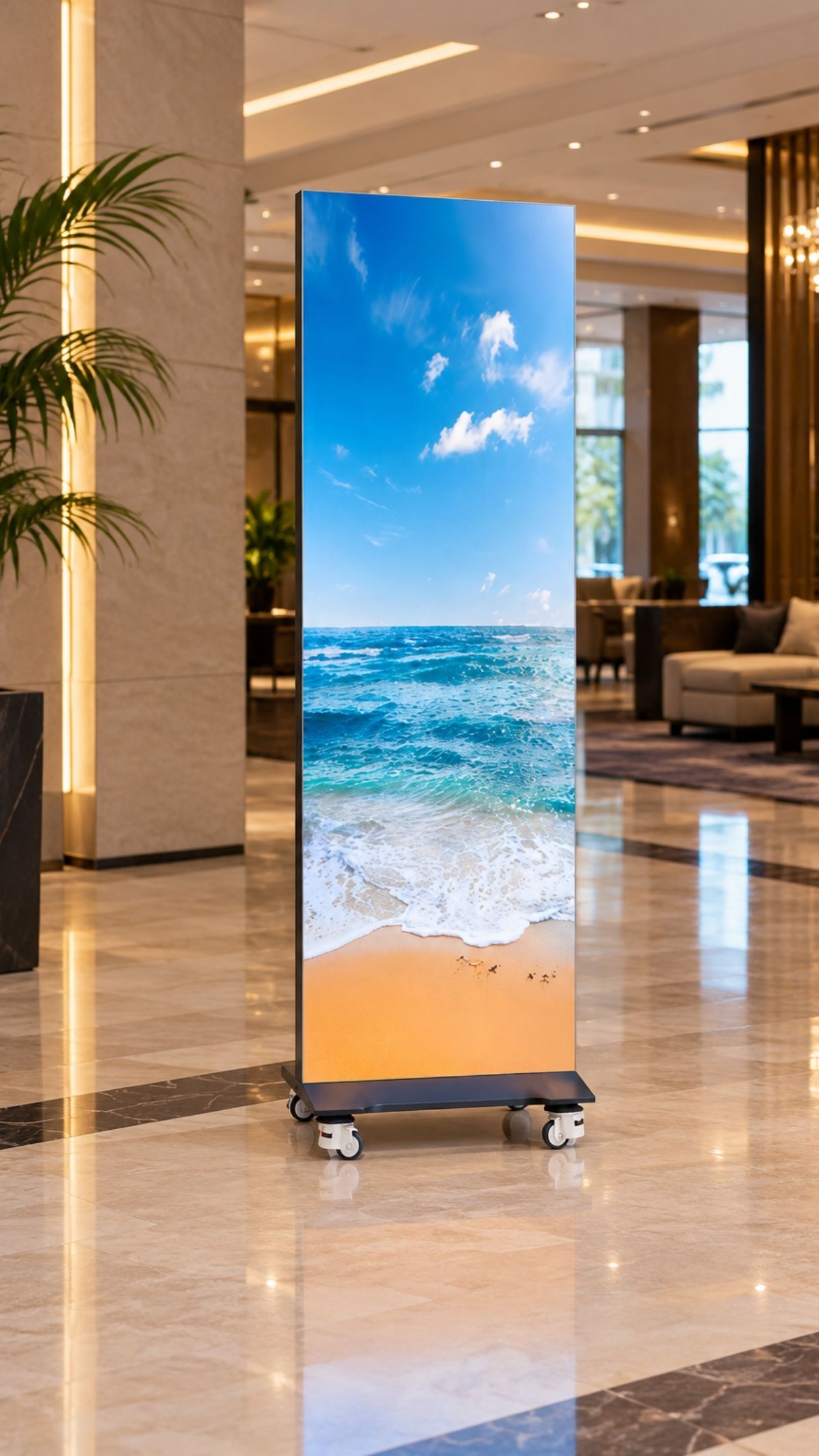
The Unilumin Umake PT 1.8 is an indoor LED poster display designed for commercial advertising and digital communication. Promallshop lists a 1.8 mm pixel pitch, approximately 600 cd/m² brightness, and a 3840 Hz refresh rate. These specifications provide a starting point for evaluating the product, although the final configuration should be confirmed before ordering.
Unilumin Umake PT 1.8 specifications
Specification | Published details |
Brand | Unilumin |
Model | Umake PT 1.8 |
Model number | UMAKE-PT1.8 |
Display technology | LED |
Pixel pitch | 1.8 mm |
Resolution | 344 × 1032, as listed |
Brightness | Approximately 600 cd/m² |
Refresh rate | 3840 Hz |
LED type | SMD |
Cabinet | Precision die-cast design |
Intended environment | Indoor |
Installation | Floor or wall mounting, as listed |
Price | ₦4,500,000, as listed |
Warranty | 24 months, as listed |
Source: Promallshop’s product listing. Confirm the resolution, installation accessories, warranty coverage, and other configuration-dependent details with the supplier before purchase.
What does a 1.8 mm pixel pitch mean?
Pixel pitch refers to the distance between the centres of neighbouring pixels, measured in millimetres. A smaller pixel pitch generally allows a display to reproduce finer detail at a closer viewing distance, assuming other display characteristics are comparable.
For retail businesses, this matters when customers will view the screen from relatively nearby. Product images, text, and branding may appear more defined when the pixel pitch suits the viewing distance.
However, pixel pitch alone does not determine overall image quality. Content resolution, display calibration, source video quality, and viewing conditions also affect the result.
How does 600 cd/m² brightness affect visibility?
Brightness is commonly measured in candelas per square metre, written as cd/m² or nits. The Umake PT 1.8 listing specifies approximately 600 cd/m², making the figure a useful reference when assessing indoor applications.
In a controlled indoor environment, this brightness may be appropriate for displaying advertisements and product visuals. However, strong sunlight through shop windows or intense ambient lighting can affect visibility.
Therefore, retailers should assess the intended installation location before deciding whether the display’s brightness is sufficient.
Why does a 3840 Hz refresh rate matter?
Refresh rate describes how frequently a display updates its image, while the video frame rate describes how many distinct frames the source video supplies each second. These are related but different measurements.
A 3840 Hz display refresh rate can help reduce visible flicker and improve how the screen appears when captured by cameras. This may be useful for retail launches, promotional videos, and social media recordings.
Nevertheless, the final camera result also depends on exposure settings, shutter speed, and the display controller. A high refresh rate alone does not guarantee perfect footage.
What is SMD LED technology?
SMD means surface-mount device. In LED displays, SMD packages contain the light-emitting components mounted on electronic circuit boards.
This technology is used in many commercial LED screens. The actual viewing experience depends on the full display design, including pixel pitch, processing, brightness, and calibration.
The Umake PT 1.8 listing also describes a die-cast cabinet. This type of construction can support a precise enclosure, but buyers should still confirm the product’s weight, dimensions, access requirements, and mounting hardware.
Unilumin Umake PT 1.8 Price in Nigeria
The Unilumin Umake PT 1.8 is listed on Promallshop at ₦4,500,000, with a displayed previous price of ₦5,625,000 and a 24-month warranty. Because online prices and promotional offers can change, buyers should confirm the current price, stock availability, and final supply terms directly with Promallshop before making a purchasing decision.
What should the quoted price include?
A product’s listed price does not necessarily represent the total cost of deploying it in a retail environment. Before placing an order, ask the supplier to clarify whether the quotation includes:
- The LED poster display and all required components.
- A floor stand, wall-mounting hardware, or other installation accessories.
- A content controller or playback system, if required.
- Installation, configuration, and testing.
- Staff training or content-management support.
- Delivery and any applicable taxes.
- Warranty terms and after-sales service.
These items may be included, optional, or charged separately. A written quotation will help you compare suppliers fairly.
Is the Unilumin Umake PT 1.8 worth the price?
The answer depends on how frequently the business advertises, how important visual presentation is, and how much value it expects to obtain from repeated use.
For a retailer running frequent promotions, a reusable display may offer greater flexibility than repeatedly producing printed materials. However, a small shop with infrequent campaigns may find printed signage or a less expensive digital screen more practical.
Rather than assuming the display will increase sales, establish measurable goals. Track campaign changes, product enquiries, customer interactions, and promotional performance before and after installation.
LED Poster Display vs LCD Digital Signage for Retail
LED poster displays and LCD digital signage both support digital advertising, but they use different display technologies. An LED poster display typically uses an array of LEDs to form the image, whereas an LCD screen uses a liquid-crystal panel with a backlight or another illumination arrangement. The right choice depends on the application, viewing distance, budget, and desired visual effect.
Comparison factor | LED poster display | LCD digital signage |
Image formation | LEDs form the image directly | Liquid crystals modulate light from a backlight |
Pixel pitch | Important when evaluating fine-pitch LED | Usually evaluated by native pixel resolution and pixel density |
Close viewing | Depends on pixel pitch and screen configuration | Can be suitable for close viewing at native resolution |
Screen format | Some products use a tall, poster-like format | Available in many conventional screen sizes and aspect ratios |
Installation | Depends on cabinet, stand, and mounting design | Depends on display size and mounting system |
Initial cost | Varies significantly by size and configuration | Varies by size, panel quality, and commercial features |
Best-fit applications | Digital posters and selected high-impact retail installations | Menus, information screens, promotional videos, and general signage |
Which display is better for a retail store?
An LED poster may suit a retailer that wants a dedicated, high-impact advertising format with fine-pitch LED technology. An LCD screen may be a better fit when conventional screen sizes, familiar installation methods, or a lower initial budget are priorities.
Neither technology is universally superior. Compare the actual models at the expected viewing distance, and consider maintenance, warranty, content playback, and total installation cost.
Best Uses of LED Poster Displays in Retail Stores
LED poster displays are useful when a retailer needs to communicate changing messages in a visible location. They can support product promotions, new arrivals, seasonal campaigns, and brand storytelling. The strongest applications place the screen where customers can see the message and give them a clear reason to pay attention.
Supermarkets and convenience stores
Supermarkets can use digital posters to highlight weekly deals, new products, loyalty programmes, and seasonal offers. For example, a screen near a product aisle could introduce a special offer while a separate display near the entrance promotes current campaigns.
However, ensure that advertised prices and offers remain accurate. Outdated promotions can confuse customers and create unnecessary work for staff.
Fashion and lifestyle stores
Fashion retailers can use short videos, product imagery, and collection announcements to complement their physical displays. A screen near the entrance could introduce a new collection, while another near a relevant department highlights accessories or seasonal items.
The content should support the merchandise rather than compete with it. Simple visuals and clear messages are usually easier to understand while customers are moving around the store.
Electronics and appliance showrooms
Electronics retailers can use LED posters to demonstrate product features, advertise bundle offers, or announce launches. Dynamic visuals may help introduce a product before a salesperson provides a more detailed explanation.
For example, a showroom could rotate between product highlights, financing information, and upcoming demonstrations. All claims, prices, and promotional conditions should be verified before they appear on the screen.
Shopping malls and brand activations
Mall retailers and advertising agencies can use digital poster displays for campaign launches, event announcements, and brand messages. In temporary activations, the display may complement a physical stand or product demonstration.
For installations intended for shared spaces, obtain the relevant property or venue approval. Also confirm power availability, mounting safety, pedestrian clearance, and the rules governing advertising content.
A practical retail example
Imagine a Lagos electronics shop preparing for a festive sales campaign. Rather than printing separate posters for televisions, accessories, and appliances, the retailer could use a digital display to rotate between approved campaign creatives.
The team would still need to prepare the content, schedule updates, and check that prices remain correct. After the campaign, the retailer could compare customer enquiries and sales of promoted items with a similar period or previous campaign.
This is a practical measurement approach, not a guarantee that digital signage will produce a specific increase in sales.
How to Choose the Right LED Poster Display
Choosing an LED poster display starts with the business objective, not the product specification sheet. Buyers should identify where the screen will be installed, how far away customers will stand, what content it will show, and what the full project will cost. This process helps prevent an expensive purchase that does not fit the intended space.
Define the purpose
Decide whether the screen will advertise promotions, display product videos, communicate directions, or support brand campaigns. A clear purpose helps determine the required screen format and content capabilities.
Measure the viewing distance and space
Measure the installation area and the typical distance between the screen and viewers. A fine pixel pitch may be useful for close viewing, but it should be considered alongside resolution and screen dimensions.
Also check the available floor area, wall structure, customer traffic, and visibility from the intended approach.
Check brightness and lighting
Observe the location at different times of day. Consider daylight, overhead lighting, reflections, and the distance from the screen.
For indoor installations near large windows, ask the supplier whether the listed brightness is suitable for the actual conditions.
Confirm content and control options
Find out how the display receives and plays content. Ask whether it supports the required media formats and whether content is uploaded locally or managed through a network.
If remote scheduling is important, confirm that the display and its controller support it. Do not assume every LED poster includes the same software or connectivity options.
Request a complete quotation
Ask for the display price, accessories, installation, delivery, training, and warranty details in writing. Then compare the full cost with alternative displays that meet the same requirements.
For businesses operating in Nigeria, Ghana, or Côte d’Ivoire, also clarify delivery arrangements, service coverage, and who will handle technical support after installation.
Benefits and Disadvantages of LED Poster Displays
LED poster displays offer flexibility, reusable advertising content, and opportunities for more dynamic in-store communication. However, they also require an upfront investment, reliable electricity, content preparation, and maintenance. Evaluating both sides helps retailers decide whether the technology fits their marketing budget and operating needs.
Key benefits
- Flexible content: Update messages without printing a new poster for each campaign.
- Dynamic visuals: Combine images, video, text, and animation.
- Reusable equipment: Use the same screen for different campaigns over time.
- Consistent branding: Maintain a standard visual identity across promotions.
- Campaign flexibility: Change messages when products, prices, or priorities change.
Potential disadvantages
- Higher initial cost: Commercial LED displays can require a substantial investment.
- Electricity requirements: The display needs power during operation.
- Content workload: Someone must prepare, review, and update the advertising material.
- Installation considerations: Mounting, space, ventilation, and cable management need attention.
- Maintenance requirements: Components, controllers, and connections may need servicing.
- Technology limitations: Brightness, viewing distance, and content compatibility vary by model.
How can a business assess its return on investment?
Start by estimating the full cost of ownership, including the purchase, installation, electricity, maintenance, and content production.
Next, identify what success looks like. Depending on the campaign, useful measures may include sales of promoted products, customer enquiries, offer redemption, or the time staff spend changing promotional materials.
Compare the results with an appropriate baseline. This provides a more defensible basis for evaluating the display than assuming every customer who sees it will make a purchase.
Best Practices for Using LED Poster Displays
An LED poster display works best when its content is easy to understand, relevant to the audience, and appropriate for the location. Retailers should keep messages concise, use legible text, maintain accurate pricing, and review the screen regularly. Technical quality matters, but good content and consistent operation are equally important.
Keep the message simple
A customer walking past a screen may have only a few seconds to notice it. Therefore, focus each creative on one main message, such as a product launch, discount, or event.
Use a clear headline, a strong product visual, and a simple call to action when appropriate. Avoid filling the screen with long paragraphs or too many competing offers.
Design for the actual display
Create content in the correct aspect ratio and resolution for the screen. Test text size, image quality, colour contrast, and video playback before publishing.
Because the Umake PT 1.8 listing describes a 344 × 1032 resolution, buyers should verify the actual configured output dimensions and content requirements with the supplier rather than relying on a generic LED poster template.
Update campaigns consistently
Assign responsibility for checking prices, dates, stock availability, and promotional conditions. In addition, remove expired campaigns promptly so customers are not shown outdated information.
If multiple locations use digital signage, establish a simple approval process to keep brand messaging consistent while allowing for local offers.
Monitor performance
Record the campaigns displayed, the dates they ran, and the outcomes relevant to the business. When possible, compare similar products or time periods to understand whether the display is contributing to the intended goal.
This approach helps the retailer improve content over time instead of treating the screen as a one-time purchase.
Common Buying Mistakes and Future Trends
Retailers can avoid many display problems by checking technical specifications, installation requirements, and total cost before ordering. They should also confirm the supplier’s warranty and support arrangements. As digital signage evolves, content scheduling, remote management, and data-informed campaign planning are becoming increasingly relevant considerations for multi-location businesses.
Common mistakes to avoid
Buying based on pixel pitch alone: A 1.8 mm pixel pitch is useful information, but it does not tell you everything about image quality or suitability. Consider resolution, brightness, screen dimensions, and viewing distance together.
Ignoring installation costs: A quoted screen price may not include stands, mounting hardware, electrical work, or installation services. Request an itemised quotation.
Assuming outdoor suitability: The Umake PT 1.8 listing identifies the product as an indoor display. Do not install it outdoors or in exposed conditions without explicit confirmation from the manufacturer or supplier that the exact configuration is suitable.
Overlooking after-sales support: Confirm warranty coverage, repair arrangements, and the availability of technical assistance before purchasing.
Using poor-quality content: Blurry images, excessive text, and incorrect aspect ratios can undermine an otherwise capable display.
What should retailers expect from future digital signage?
Digital signage systems can increasingly be integrated into broader marketing workflows, including scheduled campaigns, centralised content management, and coordinated messaging across locations.
For retailers, the practical benefit is not simply having a more advanced screen. It is the ability to manage messages more consistently and respond to changing promotional needs.
However, these capabilities depend on the hardware, controller, software, and network setup. Buyers should verify which features are included with the selected display rather than assuming every model supports cloud management, analytics, or automated content scheduling.
Conclusion
The Unilumin Umake PT 1.8 is an indoor LED poster display worth evaluating for retailers that want flexible digital advertising and a dedicated format for promotional content. Its published 1.8 mm pixel pitch, approximately 600 cd/m² brightness, and 3840 Hz refresh rate provide useful starting points for assessing the product.
Promallshop lists the display at ₦4,500,000, but the final buying decision should account for installation, accessories, content requirements, warranty, and support. By comparing these factors with the needs of the store, businesses can determine whether an LED poster display is a sensible long-term addition to their retail advertising strategy.
FAQs
The Unilumin LED Poster Display Umake PT 1.8 is an indoor digital signage product designed to display advertising, videos, images, and promotional messages. Its published specifications include a 1.8 mm pixel pitch, approximately 600 cd/m² brightness, and a 3840 Hz refresh rate.
The product listing describes the display as suitable for videos, animations, images, text, and branding. However, buyers should confirm supported video formats, playback options, controller requirements, and content-management features before ordering.
The published listing identifies this model as an indoor display. Therefore, it should not be assumed suitable for direct sunlight, rain, or exposed outdoor installation. Ask the supplier about the appropriate product and protection rating if outdoor advertising is required.
Supermarkets, fashion boutiques, electronics stores, shopping malls, showrooms, and other retailers can use LED poster displays to present product information and promotions. The best application depends on the location, audience, campaign objectives, and available budget.
An LED poster display uses LEDs to form the image, while an LCD screen uses liquid crystals to control light from a backlight or other illumination system. Both can show digital advertisements, but their resolution, screen format, brightness, installation requirements, and cost vary by model.