


Table of Contents
ToggleIntroduction
A poor headset can turn a five-minute meeting into an audio obstacle course. Your colleagues hear keyboard clicks, the air conditioner becomes a guest speaker, and someone eventually asks, “Can you hear me?”
For Microsoft Teams, Zoom and other video-conferencing platforms, the right headset does more than play sound. It needs to capture your voice clearly, reduce unwanted background noise, remain comfortable during long meetings and connect reliably to the devices your business already uses.
This guide explains what to look for and compares practical options for corporate offices, SMEs, call centers, remote workers and hybrid teams in Nigeria, Ghana and Côte d’Ivoire.
Table of Contents
- Introduction
- What makes a good video conferencing headset?
- What is the best headset for Teams and Zoom?
- Wired vs Wireless Headsets: Which Is Better?
- Recommended headsets for Teams, Zoom and business calls
- Best Headsets by Use Case
- ANC vs Microphone Noise Cancellation: What’s the Difference?
- Microsoft Teams and Zoom certification: does it matter?
- How to Choose the Right Headset for Your Business
- What Should Call Centers Look for in a Headset?
- What about remote and hybrid workers?
- Common Mistakes When Buying a Business Headset
- Future Trends in Business and Video Conferencing Headsets
- Conclusion
- FAQs
What makes a good video conferencing headset?
A good video conferencing headset needs to solve two separate audio problems: what you hear and what other people hear from you. Speaker quality affects how clearly you hear meetings, while microphone quality determines how clearly colleagues hear your voice. Comfort, connectivity and software compatibility then determine whether the headset works well over an entire workday.
1. Microphone quality
For business calls, microphone performance is often more important than impressive music specifications.
Look for a dedicated boom microphone, multiple microphones or a documented noise-cancellation system. A microphone positioned close to the mouth can capture speech more effectively than a distant microphone built into a laptop.
2. Noise cancellation
The phrase “noise cancelling” can mean different things.
Active Noise Cancellation (ANC) primarily helps the headset wearer reduce unwanted sound coming into the headphones.
Microphone noise cancellation works in the opposite direction. It helps reduce unwanted environmental sounds from being transmitted to the person you’re speaking with.
That distinction matters.
If you work beside a busy road, ANC can make it easier for you to concentrate. If you work in a call center where several agents are speaking nearby, microphone noise cancellation is particularly important because your customer needs to hear you clearly.
3. Comfort
A headset can have excellent specifications and still become an expensive paperweight if it hurts after two hours.
For extended use, consider:
- Lightweight construction
- Adjustable headband
- Soft ear cushions
- Reasonable clamping pressure
- Balanced weight
- Breathable materials
- A microphone boom that can be positioned correctly
4. Connectivity
The main options are USB, Bluetooth, DECT and traditional desk-phone connections such as Quick Disconnect or RJ9.
USB is particularly useful for employees who spend most of their time at a computer. Bluetooth is more flexible for people who switch between computers and phones. DECT can make sense for professional wireless deployments where range and dedicated business communications matter.
What is the best headset for Teams and Zoom?
The best headset depends on where and how you work. Wired USB models are usually the simplest option for fixed workstations, while wireless headsets make more sense when employees need to move around. For noisy offices and call centers, microphone noise cancellation is particularly important because it helps the person on the other end hear your voice clearly.
For example, the Logitech H390 combines a USB connection with a noise-cancelling microphone and inline controls. Logitech’s Zone 305 adds wireless connectivity and two noise-cancelling microphones, while Zone Wireless 2 offers more advanced ANC, microphone processing and business-management features.
For dedicated call-center environments, models such as the VT series and enterprise call-center headsets are worth considering because their designs are aimed at extended voice communication rather than general entertainment.
User / environment | What to prioritize | Suitable type |
Remote worker | Comfort, microphone clarity, USB/Bluetooth | USB or wireless |
Corporate employee | Platform compatibility, call controls, comfort | Business UC headset |
Open-plan office | Microphone noise cancellation, ANC | ANC wireless or wired |
Call center | Voice clarity, durability, noise rejection | Enterprise call-center headset |
Home call center | Mic noise cancellation, comfort | USB or wireless |
IT deployment | Certification, manageability, compatibility | Business-certified headset |
Mobile professional | Bluetooth, battery, multipoint | Wireless headset |
Fixed workstation | Reliability, no charging | USB wired headset |
Wired vs wireless headsets: which is better?
Neither connection is universally better. Wired headsets are attractive for fixed desks because they do not need battery charging and are usually straightforward to deploy. Wireless headsets are more convenient for mobile workers who need to leave their desks while remaining connected.
Wired headsets
Pros
- No battery to charge
- Simple plug-and-play operation
- Consistent connection
- Usually lower purchase cost
- Excellent for fixed workstations
- Suitable for high-volume call environments
Cons
- Cable management
- Limited movement
- USB ports can become a consideration in large deployments
A model such as the Logitech H390 illustrates this approach. It uses USB connectivity, inline controls and a noise-cancelling microphone.
Wireless headsets
Pros
- Freedom of movement
- Less cable clutter
- Bluetooth connectivity
- Convenient for hybrid workers
- Some models support multiple devices
Cons
- Requires charging
- More expensive in many cases
- Wireless connectivity can introduce additional troubleshooting
- Some features depend on specific receivers, operating systems or software
Microsoft distinguishes between USB peripherals and native Bluetooth peripherals in its Teams ecosystem, so IT teams should check the exact connection method rather than assuming that every Bluetooth headset offers identical Teams functionality.
Recommended headsets for Teams, Zoom and business calls
The following options reflect the types of headsets currently available through PromallShop and the broader business-headset market. Product availability and pricing can change.
Logitech H390: straightforward wired work headset
The Logitech H390 is a sensible option for employees who want a simple USB headset without introducing wireless charging or pairing into the workflow.
It has 30 mm drivers, a noise-cancelling microphone and inline controls for volume and mute. Logitech positions it specifically for video meetings and everyday computer use.
Best suited to:
- Remote workers
- SMEs
- Office employees
- Virtual meetings
- Training sessions
- Fixed desks
PromallShop’s current catalogue lists the H390 at ₦48,000 at the time of checking, although retail prices can change.
Logitech Zone 305: lightweight wireless option
The Logitech Zone 305 is designed for business users who want wireless connectivity without moving into a heavier premium headset.
It weighs approximately 122 g and uses two noise-cancelling microphones with a long boom. Logitech states that versions with the receiver are certified for Microsoft Teams and Zoom, while specific configurations also support Teams over native Bluetooth.
Best suited to:
- Hybrid workers
- Corporate employees
- Employees switching between desk and mobile work
- Large-scale deployments where weight matters
Microsoft’s current certification list includes the Logitech Zone 305 as a Teams-certified headset.
Logitech Zone Wireless 2: premium wireless business headset
Zone Wireless 2 is aimed at professionals who need more advanced noise management and wireless functionality.
It uses multiple MEMS microphones, hybrid ANC and Logitech’s Advanced Call Clarity feature. Logitech lists up to 15 hours of talk time with ANC enabled and up to 18 hours with ANC disabled, although actual battery life varies by usage and computing conditions.
The headset is certified for Microsoft Teams and Zoom, with different functionality depending on whether it is connected through the receiver or native Bluetooth.
Best suited to:
- Executives
- IT professionals
- Hybrid employees
- Open-plan offices
- Professionals who spend many hours on calls
VT headsets: built for call-center environments
VT headsets occupy a different part of the market. Rather than being designed primarily as general-purpose headphones, these models are aimed at business communications and call-center use.
PromallShop’s current range includes the VT 6300 USB headset with dual noise-cancelling microphones, VT Duo X140 with ENC and a busylight, VT Flow wireless ANC Bluetooth headset, VT6200UNC-D and several wireless models.
Best suited to:
- Call centers
- BPO teams
- Customer-service departments
- Sales teams
- Noisy offices
- Employees handling calls for several hours each day
For a call center, the important question is not simply “Does it have ANC?” Instead, ask whether the microphone is designed to reject nearby speech and office noise.
Dell and Poly business headsets
Dell and Poly also have business-focused headsets for professional communications. Microsoft’s current Teams certification catalogue includes Dell models such as the WL7024, WH5024 and WL5024, as well as numerous Poly headsets.
PromallShop’s catalogue also currently includes the Dell WL5022 and Poly Blackwire 5220.
For organizations standardized on Dell hardware, a Dell headset can simplify procurement and support. Poly, meanwhile, has a long history in professional voice and unified communications equipment.
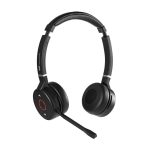
Best headset by use case
Choosing a headset by brand alone is usually less useful than choosing it by work environment. A headset for a quiet home office has different requirements from one used by 50 agents in a busy contact center.
Use case | Recommended characteristics |
Zoom meetings at home | USB or lightweight wireless |
Microsoft Teams office calls | Teams-certified business headset |
Noisy home | Mic noise cancellation + ANC |
Open-plan office | Strong microphone noise rejection |
Call center | Enterprise mic + durability + comfort |
Hybrid worker | Wireless + multipoint/device flexibility |
IT department | Certification + fleet management |
Executive | Premium wireless + ANC + comfort |
ANC vs microphone noise cancellation
ANC and microphone noise cancellation solve different problems. ANC reduces unwanted sounds that the headset wearer hears, while microphone noise cancellation reduces unwanted environmental sounds captured by the microphone. For meetings, call centers and customer support, both can be valuable, but microphone performance deserves particular attention.
Think of the two systems as two doors.
ANC closes the door between the outside world and your ears.
Microphone noise cancellation closes the door between the outside world and your voice.
That distinction is one of the most commonly overlooked aspects of headset shopping.
PromallShop’s own VT Flow article provides additional information about how noise cancellation is used in a work environment.
Microsoft Teams and Zoom certification: does it matter?
Certification is useful because it provides evidence that a device has been tested against platform-specific requirements. Microsoft says Teams-certified devices undergo testing for quality and integration, while Zoom maintains its own certification program for workplace headsets and other hardware.
Microsoft’s certification program covers areas such as audio quality, user experience, device management and security. Certified audio devices can also provide features such as call controls and mute synchronization.
Zoom similarly maintains a certified hardware ecosystem and separates categories such as workplace headsets, native Bluetooth headsets and contact-center headsets.
However, certification should not be the only buying criterion.
A headset can be certified and still be the wrong choice for a particular employee because of weight, ear-cup design, connection type, battery requirements or workplace noise.
How to choose the right headset for your business
Start with the working environment rather than the brand.
Step 1: Identify the primary platform
Determine whether employees mainly use:
- Microsoft Teams
- Zoom
- Google Meet
- Cisco Webex
- VoIP softphones
- Desk phones
Then check the manufacturer’s compatibility information.
Step 2: Determine the noise level
Ask whether employees work:
- Alone at home
- In private offices
- In open-plan offices
- In call centers
- Near machinery
- In shared rooms
The noisier the environment, the more important microphone noise rejection becomes.
Step 3: Decide wired or wireless
Choose wired if employees remain at a desk and reliability is the priority.
Choose wireless if employees frequently move around, switch devices or need a cable-free workspace.
Step 4: Check the connection
Do not buy a headset until you know whether your computers require:
- USB-A
- USB-C
- Bluetooth
- A wireless receiver
- 3.5 mm audio
- RJ9
- QD
Step 5: Consider working hours
Someone attending two meetings per day has different comfort requirements from a call-center agent wearing a headset for an entire shift.
For long shifts, prioritize weight, ear-cup comfort, headband adjustment and microphone positioning.
Step 6: Check deployment requirements
For corporate procurement, also consider firmware updates, device management, warranties and certification.
A headset that works beautifully for one employee may become difficult to manage when deployed across hundreds of users.
What should call centers look for in a Headset?
Call centers should prioritize microphone performance, comfort, durability and connection compatibility. Agents may spend most of their working day communicating through a headset, so a consumer-oriented model is not automatically the right choice.
Look for:
- Noise-cancelling microphone
- Lightweight construction
- Comfortable ear cushions
- Durable headband
- Acoustic protection
- USB or QD connectivity
- Replaceable accessories where possible
- Clear warranty terms
- Compatibility with the organization’s VoIP platform
PromallShop’s catalogue includes dedicated VT models as well as Logitech and other business headsets. RapidBTS also maintains a dedicated call-center headset category containing options such as Grandstream, Mairdi, Sennheiser and VT accessories.
What about remote and hybrid workers?
Remote workers usually benefit from a headset that balances portability, comfort and microphone performance. A wireless headset can make it easier to move around the home, while a wired USB model removes charging from the equation.
For hybrid teams, wireless models such as Logitech Zone 305 and Zone Wireless 2 are particularly relevant because they are designed around business communication rather than entertainment alone. Logitech lists both models in its business headset range, and Microsoft’s current certification catalogue includes them for Teams.
Common mistakes when buying business headsets
Several purchasing mistakes appear repeatedly.
Choosing headphones instead of a headset
Headphones can sound excellent but may have microphones that are poorly suited to professional calls.
If voice communication is central to the job, prioritize microphone performance.
Confusing ANC with microphone noise cancellation
A headset can have impressive ANC while still allowing your colleagues to hear your keyboard, nearby conversations or fan noise.
Check the microphone specifications separately.
Buying purely on battery life
Twenty-five hours of battery life does not compensate for an uncomfortable headset or poor microphone.
Battery life is important, but it should sit alongside comfort, call quality and connectivity.
Ignoring certification
A headset may technically connect to Teams or Zoom without offering the same level of platform integration as a certified device.
For business procurement, certification is worth checking.
Buying the cheapest model for every employee
Low upfront cost can become expensive when headsets break frequently, cause poor call quality or create support problems.
For large teams, evaluate total cost of ownership rather than purchase price alone.
Future Trends in Business and Video Conferencing Headsets
Business headsets are increasingly becoming intelligent collaboration devices rather than simple speakers and microphones. Newer models combine noise suppression, platform integration, wireless connectivity, firmware updates and device-management capabilities.
Microsoft’s current Teams ecosystem increasingly emphasizes certified personal peripherals, while manufacturers are adding features designed around AI-assisted communication and noise suppression.
For IT departments, that means the purchasing conversation is gradually changing from “Which headset sounds good?” to “Which headset integrates reliably into our communication environment?”
That is a much better question.
Conclusion
The best headset for Microsoft Teams, Zoom and video conferencing is the one that matches the user’s environment, platform and working pattern.
For a simple wired setup, a model such as the Logitech H390 offers USB connectivity, inline controls and a noise-cancelling microphone. For wireless business use, the Logitech Zone 305 provides a lightweight option, while Zone Wireless 2 adds more advanced microphone and ANC features. For call centers and particularly noisy environments, dedicated enterprise models such as VT headsets deserve consideration.
Before purchasing, evaluate five things first: microphone quality, comfort, connectivity, platform compatibility and the amount of background noise in the user’s workspace.
A good headset should disappear into the workflow. The meeting should be about the people talking, not the technology struggling to let them talk.
FAQs
The right headset depends on the user's environment. For straightforward wired work, the Logitech H390 is a practical option. For wireless business use, Logitech Zone 305 and Zone Wireless 2 provide more mobility and business-focused features. Call centers may benefit from dedicated enterprise headsets with stronger microphone noise rejection.
Not universally. Wired headsets eliminate battery management and are well suited to fixed desks. Wireless headsets provide greater mobility and reduce cable clutter. The better option depends on how employees work.
No. Noise cancellation reduces unwanted sound but does not make a user completely isolated from their surroundings. Performance depends on the headset, microphone design, environment and software processing.
ANC primarily reduces sound reaching the wearer. A noise-cancelling microphone reduces unwanted sounds captured and transmitted during a call. They solve different problems.
Bluetooth can work well for Teams, particularly with certified devices. However, functionality can vary according to the headset, computer, operating system and connection method. Microsoft maintains a specific list of certified native Bluetooth peripherals.