

Table of Contents
ToggleIntroduction
An Interactive Display is changing how businesses approach training, presentations, meetings, and collaboration. Instead of relying on a projector, laptop, and traditional whiteboard, modern organizations can bring presentation, annotation, content sharing, and collaboration together on one large touchscreen.
For IT managers, procurement managers, business executives, and facilities teams, this shift is more than a technology upgrade. It is an opportunity to create training and presentation rooms that are easier to use, more flexible, and better suited to modern workplace collaboration.
Table of Contents
- Introduction
- What Is an Interactive Display?
- Why Interactive Displays Are Changing Training Rooms
- How Interactive Displays Improve Business Presentations
- Interactive Displays and Hybrid Meetings
- Key Benefits for IT and Business Teams
- Interactive Display vs Projector vs Traditional Whiteboard
- Features to Look for in an Interactive Display
- How to Choose the Right Display for Your Room
- Common Mistakes Businesses Should Avoid
- Best Practices for Deployment
- The Future of Training and Presentation Rooms
- Conclusion
What Is an Interactive Display?
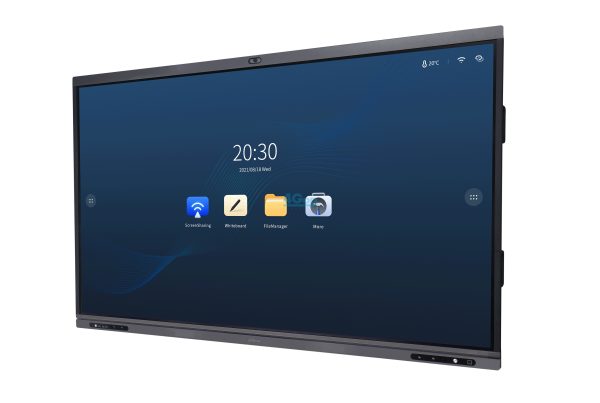
An interactive display is a large touchscreen designed for presentations, training, collaboration, and digital whiteboarding. Unlike a conventional screen, it allows users to interact directly with the content using touch or a stylus. Depending on the model, it may also support wireless screen sharing, video conferencing, built-in applications, and multi-user interaction.
In simple terms, it turns the presentation screen into a shared digital workspace.
A conventional display mainly shows information. An interactive model, however, allows people to manipulate that information. Presenters can write on slides, highlight important details, move objects, open websites, demonstrate processes, and collaborate with participants directly on the screen.
Quick answer
An interactive display transforms a presentation screen from a passive viewing surface into an active workspace for communication, training, and collaboration.
That difference becomes especially useful in corporate training rooms. Instead of asking employees to simply watch a presentation, trainers can involve them in exercises, demonstrations, brainstorming sessions, and real-time discussions.
Promallshop’s current interactive screens and display solutions include solutions designed for business, training, education, and collaboration environments.
Why Interactive Displays Are Changing Training Rooms
Interactive displays are changing training rooms because they make digital content easier to present, explain, annotate, and share. As a result, trainers can move beyond slide-based presentations and create sessions where participants actively engage with information.
Training becomes more participatory
Traditional training often follows a predictable pattern. The trainer presents information while participants listen and take notes.
With an interactive display, however, the room can become more collaborative.
For example, a trainer could display a workflow and ask participants to identify where a process could fail. One participant can then mark the relevant section on the screen while the trainer explains the issue.
Similarly, a sales trainer could display a customer journey and ask the group to move different stages around until they create the correct sequence.
The technology does not replace the trainer. Instead, it gives the trainer another way to involve the audience.
Trainers can annotate information in real time
Digital annotation is another major advantage.
A presenter can underline an important sentence, circle a figure, draw an arrow, or write a note directly over a presentation. Afterwards, those annotations can often be saved or shared, depending on the display and software being used.
Consequently, participants can leave a training session with a digital record of the ideas discussed rather than relying entirely on handwritten notes.
Multiple people can interact with content
Many modern interactive displays support multi-touch functionality. Therefore, several users can interact with digital content during collaborative exercises, although the exact number of simultaneous touch points depends on the model.
This can be useful during brainstorming sessions, workshops, technical demonstrations, and group activities.
Instead of passing a mouse from one person to another, participants can interact with the shared workspace directly.
How Interactive Displays Improve Business Presentations
Interactive displays improve business presentations by giving presenters more freedom to move between information, demonstrations, documents, and visual content. Rather than following a rigid slide-by-slide format, speakers can respond to questions and explore information as the discussion develops.
Presentations become more dynamic
Consider a product presentation.
A presenter might begin with a few slides explaining the product. Then, instead of switching between several devices, the presenter could open a product diagram, zoom into a component, annotate the design, play a demonstration video, and return to the presentation.
As a result, the audience sees a more connected presentation.
The same approach can work for financial reviews. A management team could display a chart, highlight a particular period, open supporting data, and discuss the figures without leaving the shared screen.
Interactive presentations encourage discussion
A presentation does not always need to be a one-way conversation.
For example, an executive could display a proposed business process and ask department heads to identify potential problems. Participants could then annotate the process directly.
Similarly, a project team could use the screen to review a timeline and make changes during the meeting.
This makes the display part of the conversation rather than simply the background for it.
Digital content becomes easier to demonstrate
Interactive displays are also useful when the presenter needs to demonstrate software, websites, diagrams, dashboards, or other digital content.
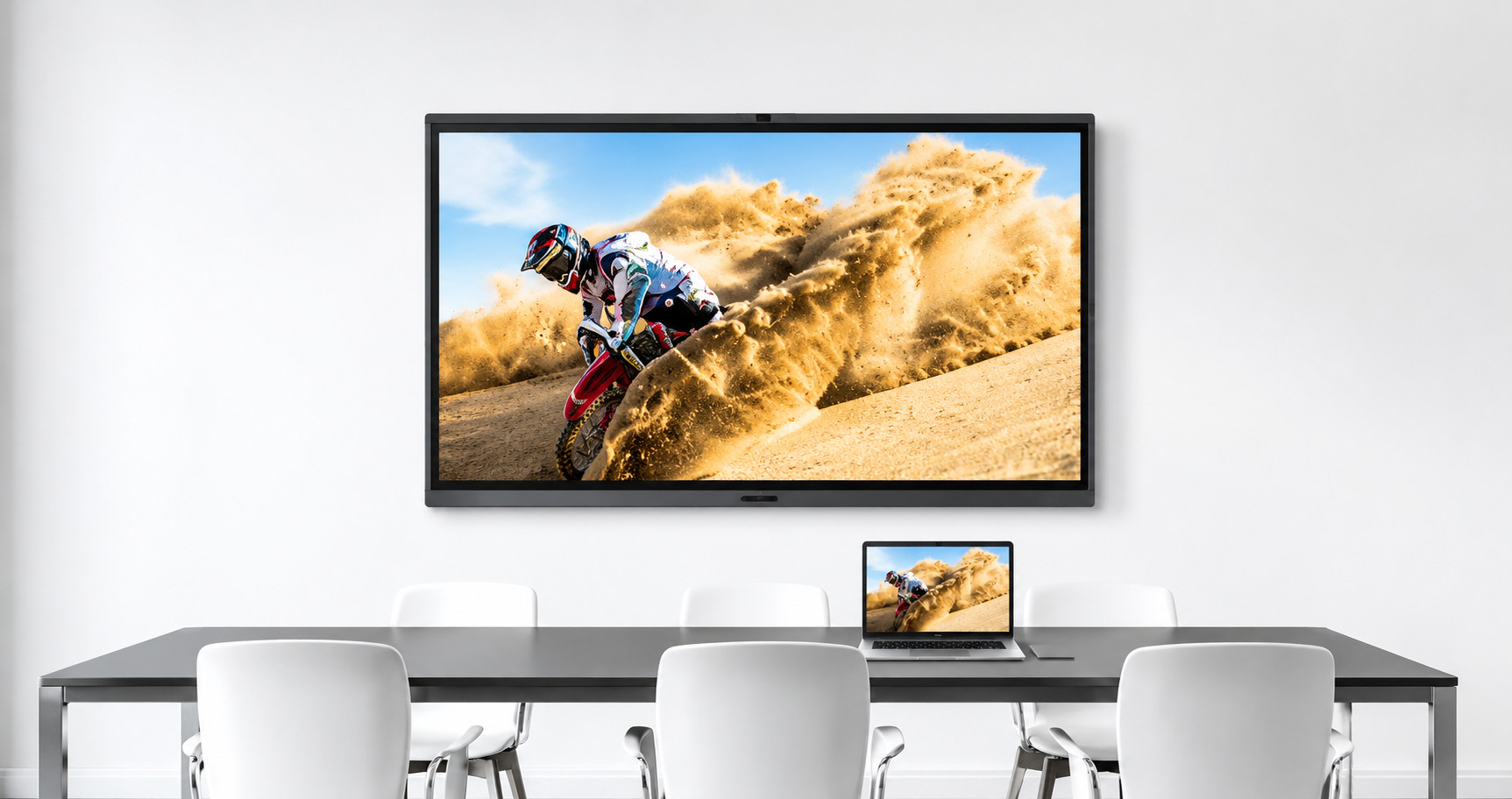
Depending on the model, users may connect laptops through HDMI or USB-C, share screens wirelessly, or use applications directly from the display.
Therefore, the right display can reduce unnecessary movement between the laptop, projector, and whiteboard.
Interactive Displays and Hybrid Meetings
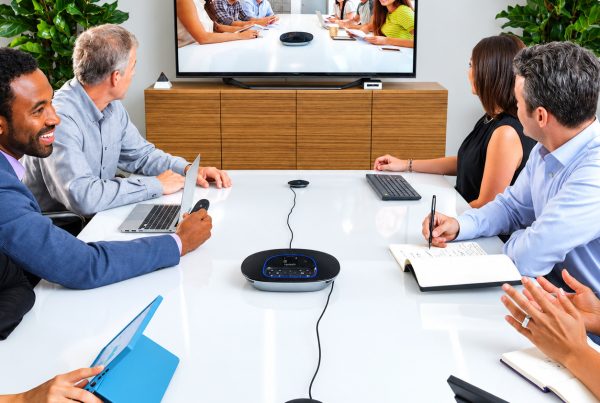
Hybrid meetings require more than a large screen. Participants in the physical room need to communicate effectively with people joining remotely, while everyone should be able to see and contribute to the same information.
An interactive display can support that experience when it is integrated with suitable cameras, microphones, speakers, network connectivity, and collaboration software.
Microsoft Teams, for example, supports interactive touch displays for Whiteboard experiences in Teams Rooms. With a compatible touchscreen, participants can interact with a shared whiteboard rather than simply viewing it. Microsoft Support: Whiteboard in Teams Rooms
How does an interactive display support hybrid training?
Imagine a trainer in Lagos conducting a session for employees in Lagos, Accra, and Abidjan.
Participants in the room can interact with the touchscreen, while remote attendees join through the organization’s collaboration platform. The trainer can use digital whiteboarding, share content, and continue the discussion without treating remote participants as an afterthought.
However, the display alone does not create a successful hybrid room.
A complete setup may also require:
- A suitable conferencing camera
- Table or ceiling microphones
- Professional speakers
- Reliable internet connectivity
- A compatible collaboration platform
- Appropriate room acoustics
- A simple method for connecting personal devices
For that reason, IT teams should evaluate the entire room ecosystem rather than purchasing a screen in isolation.
Key Benefits of Interactive Displays for Business
Interactive displays can provide different benefits depending on the organization’s goals. For IT teams, they can simplify room technology. For trainers, they can make content more engaging. Meanwhile, executives can use them to create more flexible presentations.
Stakeholder | Potential benefit |
IT Manager | Easier integration of presentation and collaboration technology |
Procurement Manager | Opportunity to consolidate several room functions |
Business Executive | More engaging presentations and executive meetings |
Facilities Manager | More flexible use of meeting and training spaces |
HR and L&D Teams | More interactive employee training |
Sales Teams | Better product demonstrations |
Trainers | Easier annotation and digital content control |
Better collaboration
The biggest advantage is often collaboration.
Instead of treating the display as an output device, employees can use it as a shared workspace. They can brainstorm ideas, review documents, map processes, discuss diagrams, and make changes in real time.
Furthermore, digital collaboration can make it easier to preserve meeting outcomes. Rather than erasing everything from a physical whiteboard at the end of a meeting, teams can save digital work where the relevant software supports it.
Less dependence on projectors
Projectors remain useful for large rooms and specific applications. Nevertheless, interactive displays can eliminate some of the challenges associated with projection, including shadows, alignment, and the need for a separate projection surface.
A display also tends to work well in rooms where ambient lighting could affect projected images.
That said, businesses should not assume that an interactive display is automatically better. Room size, viewing distance, brightness, content type, and budget should all influence the decision.
More flexible room usage
A modern training room may have several jobs throughout the day.
In the morning, employees might use it for onboarding. Later, management could use the same room for a presentation. By afternoon, the space might host a hybrid meeting.
An interactive display can support all of these activities.
Consequently, organizations can get more value from rooms that previously had a single purpose.
Interactive Display vs Projector vs Traditional Whiteboard
The right display technology depends on the room and its intended use. An interactive display is particularly strong for collaboration, while projectors may remain useful in very large spaces and traditional whiteboards still have a place in simple brainstorming environments.
Feature | Interactive Display | Projector | Traditional Whiteboard |
Touch interaction | Yes | Usually limited or requires additional technology | Physical only |
Digital annotation | Yes | Limited | No |
Wireless sharing | Often available | Depends on setup | No |
Video playback | Yes | Yes | No |
Digital whiteboarding | Yes | Depends on software | No |
Hybrid collaboration | Strong when integrated | Requires additional equipment | Very limited |
Multi-user interaction | Available on many models | Limited | Physical only |
Content saving | Often available | Limited | No |
Installation | Moderate | Moderate to high | Low |
Best suited for | Collaboration and training | Large-scale viewing | Simple brainstorming |
Which option should a business choose?
For a small meeting room that mainly displays slides, a conventional professional display may be sufficient.
For a large auditorium where the audience is far from the screen, a projector or large-format LED solution may make more sense.
On the other hand, a training room used for workshops, demonstrations, brainstorming, and collaborative exercises may benefit significantly from an interactive display.
Therefore, the best technology is the one that matches the room’s actual workflow.
Features to Look for in an Interactive Display
Choosing an interactive display based solely on screen size can lead to problems later. Instead, procurement teams should assess the complete specification and determine whether it fits the organization’s environment.
Screen size and viewing distance
A larger screen is not automatically better.
For example, a 55-inch display may work well in a small meeting room but become difficult to read from the back of a larger training room.
Before purchasing, measure the room and consider where the furthest participant will sit.
Typical business sizes include:
- 55 inches for smaller rooms
- 65 inches for medium-sized rooms
- 75 inches for larger meeting rooms
- 86 inches or larger for larger training environments
These are only starting points. Viewing distance, content type, seating layout, and room lighting should ultimately determine the appropriate size.
Resolution
4K UHD is common in modern professional interactive displays.
Higher resolution can make text, diagrams, spreadsheets, product demonstrations, and detailed visual content easier to view, especially on larger screens.
Nevertheless, resolution should not be considered in isolation. A high-resolution screen with poor viewing placement will still create a poor experience.
Touch capability
The word “touchscreen” does not tell the whole story.
Procurement teams should check:
- Number of simultaneous touch points
- Touch response
- Stylus support
- Writing accuracy
- Palm rejection
- Multi-user interaction
- Screen durability
For instance, Promallshop’s current interactive-display selection includes models with features such as 4K resolution and multi-touch capabilities. You can view the available interactive screens to compare current options.
Connectivity
Connectivity is another important consideration.
Depending on the room, the display may need:
- HDMI
- USB
- USB-C
- Wi-Fi
- Bluetooth
- Ethernet
- Wireless screen sharing
- Screen mirroring
USB-C can be particularly convenient because compatible laptops may be able to transfer video and other data through a single connection.
Operating system and software
Some interactive displays include built-in operating systems and applications. Others are designed to operate primarily with an external computer.
Neither approach is automatically better.
Instead, IT teams should consider how the device fits into existing software, device-management, security, and support policies.
Video conferencing compatibility
If the display will be used for hybrid meetings, check its compatibility with the organization’s chosen collaboration platform.
A touchscreen display is not automatically a complete conferencing system.
The room may still need separate cameras, microphones, speakers, and conferencing hardware.
How to Choose the Right Display for Your Room
The best interactive display is not necessarily the largest, newest, or most expensive model. Instead, it should provide the right combination of screen size, interaction, connectivity, software compatibility, support, and reliability for the room.
1. Define the room’s purpose
Start by identifying how the room will actually be used.
Is it primarily for:
- Employee training?
- Executive presentations?
- Client demonstrations?
- Brainstorming?
- Video conferencing?
- Hybrid learning?
- Sales presentations?
- Workshops?
Once the primary use is clear, the required features become easier to identify.
2. Measure the room
Next, assess the physical environment.
Consider:
- Room dimensions
- Seating capacity
- Viewing distance
- Screen mounting position
- Lighting conditions
- Power availability
- Network access
- Cable routes
- Camera position
- Speaker and microphone placement
This process can prevent expensive changes after installation.
3. Identify your collaboration platform
If the organization already relies on Microsoft Teams, Zoom, Google Meet, or another platform, compatibility should be part of the procurement requirements.
For example, Microsoft explains that Whiteboard functionality behaves differently depending on whether a Teams Room uses a touchscreen or a standard display. With a compatible touch display, users can interact directly with the whiteboard.
4. Consider IT management
For organizations with several meeting or training rooms, device management becomes increasingly important.
Ask whether IT administrators can:
- Configure devices remotely
- Apply updates
- Monitor device status
- Manage applications
- Control user access
- Troubleshoot common issues
A room technology strategy should remain manageable as the organization grows.
5. Calculate total cost of ownership
The purchase price is only one part of the investment.
Also consider:
- Installation
- Wall mount or stand
- Cabling
- Cameras
- Microphones
- Speakers
- Software
- Warranty
- Support
- Maintenance
- Network infrastructure
- Energy consumption
Common Mistakes Businesses Should Avoid
A well-designed interactive display project can still fail if the surrounding technology and user experience are overlooked.
Buying based only on price
The cheapest option may not offer the durability, connectivity, support, or software compatibility required for a corporate environment.
Instead, compare the total solution cost and expected usage.
Choosing the wrong screen size
A display that looks impressive in a showroom may not be suitable for the actual room.
Therefore, always assess viewing distance before deciding on screen size.
Ignoring audio
A great display cannot fix poor meeting audio.
In hybrid environments, participants still need to hear and be heard clearly. Consequently, the display should be planned alongside cameras, microphones, speakers, and other professional audio equipment.
For individual users joining calls from home or shared environments, professional call center headsets with noise-cancelling microphones can also help improve communication.
Similarly, organizations that require mobility may evaluate call center headsets wireless solutions or a call center wireless headset with mic for specific users.
For more information about professional audio equipment, you can explore business headsets and professional headset solutions.
Ignoring network requirements
Wireless screen sharing and cloud-based collaboration depend on reliable connectivity.
As a result, IT teams should assess network coverage, bandwidth, security, and access policies before deployment.
Failing to train users
Even a well-designed system can remain underused if employees do not understand its capabilities.
Therefore, organizations should provide basic training on:
- Screen sharing
- Digital whiteboarding
- Annotation
- Device connection
- Presentation controls
- Video conferencing
- Saving and sharing content
A short onboarding session can make a significant difference in adoption.
Best Practices for Deploying Interactive Displays
Successful deployment begins before the display arrives. By planning the complete room experience in advance, organizations can reduce installation problems and improve long-term adoption.
Create a room technology checklist
Before procurement, document:
- Room dimensions
- Seating capacity
- Required display size
- Mounting location
- Power requirements
- Network connection
- Collaboration platform
- Camera requirements
- Microphone requirements
- Speaker requirements
- Wireless-sharing requirements
- Security requirements
- Device-management requirements
- Warranty and support expectations
This checklist gives procurement teams a clearer basis for comparing vendors.
Standardize meeting rooms where possible
Organizations with multiple meeting rooms can benefit from standardization.
For example, if every training room uses a similar interface, employees do not have to learn a completely different system each time they move between rooms.
As a result, IT support can also become simpler.
Plan for accessibility
Accessibility should be considered during procurement rather than added later.
Screen height, visibility, font size, contrast, physical access, and alternative interaction methods can all affect how comfortably people use the room.
Therefore, facilities and IT teams should consider different user needs when planning the physical and digital environment.
Keep the user experience simple
A room with ten remotes, several adapters, and complicated connection procedures will frustrate users.
Instead, aim for a workflow that feels straightforward:
Enter room → connect device → share content → collaborate → finish meeting.
The fewer unnecessary steps users encounter, the more likely they are to use the technology confidently.
The Future of Training and Presentation Rooms
The future of business meeting rooms will not simply be about installing larger screens. Instead, displays will increasingly operate as connected parts of broader collaboration environments.
Modern rooms are already bringing together:
- Interactive displays
- Digital whiteboards
- Intelligent cameras
- Wireless presentation
- Cloud collaboration
- Room scheduling
- Digital signage
- AI-assisted meeting tools
- Automated meeting summaries
- Voice interaction
From screen to digital workspace
The biggest change is therefore conceptual.
A display used to answer one question:
“What should everyone look at?”
Modern collaboration technology increasingly answers a different question:
“What can everyone work on together?”
That distinction is likely to become even more important as businesses adopt hybrid work, digital collaboration, AI-powered productivity tools, and connected meeting-room systems.
Conclusion
Interactive display technology is transforming training and presentation rooms by changing the role of the screen itself. Rather than simply showing information, the display can become a shared workspace where employees present, annotate, brainstorm, demonstrate, and collaborate.
For IT managers, this can create a more manageable technology environment. Procurement teams can evaluate a broader range of capabilities within a single room solution. Meanwhile, executives and trainers can deliver more dynamic presentations and learning experiences.
The key, however, is to look beyond the screen.
A successful room combines the display with reliable connectivity, suitable audio, quality video, compatible collaboration software, and a simple user experience. When those elements work together, a training room becomes more than a place where people sit and watch presentations.
It becomes a space designed for how modern teams actually work.
If your organization is planning a new training room, boardroom, or collaboration space, you can explore interactive display solutions from Promallshop and compare options based on your room size, use case, and technical requirements.
FAQs
An interactive display is a large touchscreen designed for presentations, training, digital whiteboarding and collaboration. Users can interact directly with digital content instead of controlling everything from a separate computer.
The main benefits include digital annotation, touchscreen interaction, wireless content sharing, collaborative whiteboarding, multi-user interaction and better support for hybrid meetings.
Yes. They are particularly useful for training because instructors can annotate content, demonstrate processes, display multimedia and involve participants directly in activities.
In many small and medium-sized rooms, yes. However, projectors can still be appropriate for very large spaces where a much larger image is required.
There is no universal size. Smaller rooms may work well with 55- or 65-inch displays, while larger rooms may require 75-, 86-inch or larger solutions. Viewing distance and content type should guide the decision.